Designing news content for your audience requires listening, consistency

A conversation with Nick Petrie
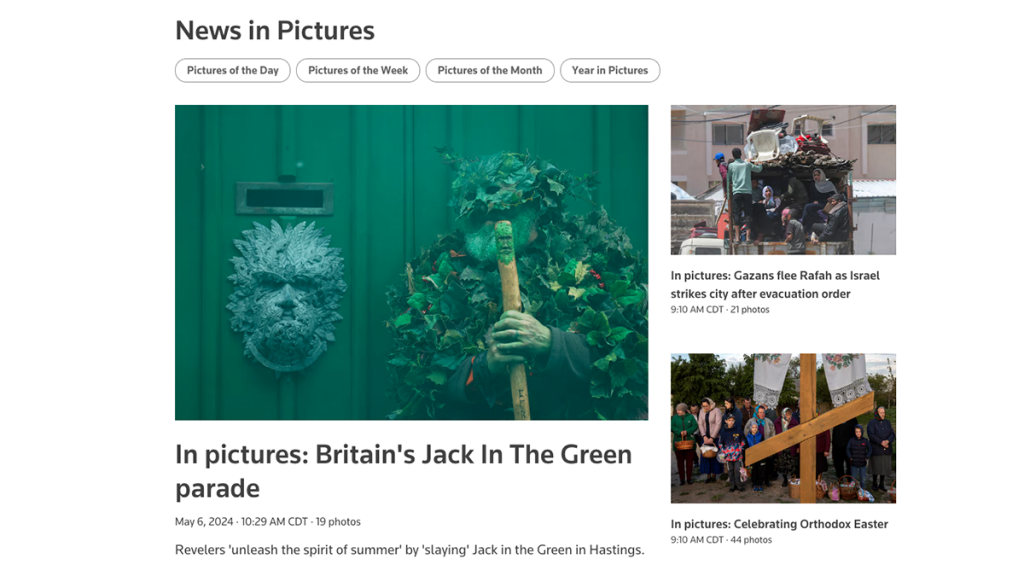
Nick Petrie, deputy digital news director at Reuters, talked about how many news organizations have adopted photo galleries because of readers’ likeliness to scroll rather than click. It’s one example of finding simple solutions to fit reader needs.

As the deputy digital news director at Reuters, Nick Petrie is often thinking about how he can bring the audience into the heart of newsroom decision-making, whether that’s through website curation, social media, audience strategy or publishing and production. He describes his current and recent roles as trying to help people work better together and use insights from audience-focused data to drive their work. Bridging these gaps between the reader and journalists, Petrie helps to create news content and products centered around the community.
This month, the Innovation in Focus team spoke with Petrie about practical tips and advice for creating a newsroom product that focuses on the readers’ needs.
Dolan: If someone is working in a smaller newsroom, how do they work within the scale that they have and still manage to think about audience needs?
Petrie: You don’t need permission to start off asking yourself: what is it that my audience needs? And really it’s one of those questions that the more people that take responsibility and ownership for it, the better it gets. Whether it’s something that can be an interactive experience or whether it’s just very straightforward reporting, it’s asking yourself, “Well, what questions will my audience have off the bat of reading this?”
A classic example is quite often, if we write about suicide in the UK, we’d mention the Samaritans at the end of the article. That has grown out of good practice editors’ guidance on reporting suicide in the UK. And it’s taken a long time for that to become an established way of being aware that you might be raising issues that people need more help on, and you can signpost that help.
You start asking yourself in all the reporting you do and all of the projects you work on, “What’s likely the next thing a reader needs, and is it appropriate for us to help them with that in terms of maintaining our code of ethics and our responsibilities as journalists? Is it advantageous to us to help with that, like can we build a service that people might pay for?” Really just start asking yourself, “How can I overlay what the business does and needs with what my readers need?”
Dolan: What is your process of figuring out what your readers need?
Petrie: I actually am a big fan of the survey. I really think that there is nothing quite as powerful as asking your readers literally what they want and need. Because it will almost always surprise you in terms of what your assumptions are and what they tell you. Now obviously sometimes you can’t survey. So then, you use the data you do have about product usage.
We do monthly surveys in all of the newsletters at Reuters, asking people, how often do you open it? What’s your motivation for opening it? Is it meeting your needs? What would you be looking for? And we overlay that with what you actually see in terms of open rates or the links that get clicked on. A good example at the moment is, the business side of Reuters would really like people to click on more links in newsletters. But people who receive the newsletters really don’t want to click on links. They like having all the information they need right there in front of them. So there’s tension between how you lay out the newsletter and all the recent surveys. Then you can turn around to the people who are arguing against it and say, look, there’s really not a strong case for doing what you’re saying. We need to find a different way to solve your problem.
It’s usually really easy to do a survey because at the end of an article you can pop a link saying, “We really appreciate your help. We want to improve this. Please tell us what you think.” It’s much easier than lots of other businesses, because you have a relationship with your readers where it’s genuinely symbiotic. Like, you tell us what you need and we can go out and do it for you.
Dolan: How do you balance something flashier with something that you think is going to work well based on what the audience needs?
Petrie: So what you’ll learn is simple, straightforward and easy is always the best. The fact that lots of news organizations now tend to do articles with multiple large pictures in them, is because people scroll but they don’t really click. It’s really difficult to get people to deeply explore something. The more layers you have, the less likely they are to click unless they’re particularly motivated. If you’re looking for a restaurant, and you’re using an Eater guide, then you might select food cuisine style and a price range to filter down to what you need because you’ve got an important first date coming up, and you want to make sure you really nail that restaurant. But lots of times people’s motivation isn’t that high. So, the easier you make it to access information, the better. The other thing is something like this you can invest in over time, so you can make it a little better each year.
Dolan: Once you’ve launched a product or news content when considering the audience, how do you then measure that success? What kinds of things do you look at?
Petrie: It depends what it is. The trick to that is: what did you want it to achieve? Because that’s what defines whether it’s a success or not.
Is it just making the part of your audience realize that there’s something for them? A big problem lots of news organizations have is their staff isn’t necessarily very diverse, so lots of people don’t see themselves reflected in the publication, so they don’t think a publication is for them.
Or it might be that it needs to make a certain amount of money. Does it have a sponsor, or is it that you want to be able to get a sponsor in the future? Or you need to demonstrate that it had an engaged audience: How many people saw it? How often did they revisit it? How long did they spend using it? So it’s very much dependent on what you’re setting out to achieve. You can have an honest conversation internally about what’s the point of doing this and what’s the opportunity in the future.
Dolan: When do you use existing tools or structures, and when do you know it’s time to build something new or dedicate time and resources to building something from scratch?
Petrie: That is a difficult question. Always start with the free tools available or the affordable tools available. If there’s a point at which you’re really trying to chase down an opportunity you think is there and you just can’t get a good experience out of the tools you have, then you can yourself, what’s the upside? If we spend some money on this, what do we think the return is going to be? Is that a good return on the investment? Are we going to add a complexity that over time is going to become too difficult to maintain? What are we committing to? And something I talk about a lot in the bigger newsrooms is some things are really difficult to fix in code, but they’re really easy to fix in workflow. Whereas sometimes things are really hard to change in workflow and really easy to tackle in code, and it’s important to learn how to notice what those trade-offs are.
Dolan: How do we find a way to change something up without overburdening a small team?
Petrie: Consistency is one of the things I would keep in mind. If you work at a problem with some consistency over time and make small but measurable improvements, it’s worth a lot more. It feels much more fun to launch some whiz-bang thing where you can be like, ‘look at this new thing we launched.’ But usually the most value comes out of small, incremental improvements that consistently make things better. And I know it sounds less fun in the first instance, but when you actually get that feedback loop – those become really powerful stories in newsrooms because it’s demonstrating impact.
Editor’s Note: This interview has been edited for clarity and brevity.

Sign up for the Innovation in Focus Newsletter to get our articles, tips, guides and more in your inbox each month!
Cite this article
Dolan, Olivia (2024, June 10). Designing news content for your audience requires listening, consistency. Reynolds Journalism Institute. Retrieved from: https://rjionline.org/news/designing-news-content-for-your-audience-requires-listening-consistency/